

Anxiety Symptoms, Causes, & Treatment
There are moments when you know something is wrong, but you cannot quite explain what. Anxiety symptoms often look this this:
Your heart is beating faster. Your mind will not stop analyzing
You replay a conversation that happened three days ago. You imagine worst-case scenarios. You feel restless, exhausted and somehow unable to relax—even when everything around you appears completely normal.
Anxiety can feel like fear, or a knot in your stomach, or a sudden thought: “What if something happens?”
And sometimes the most frightening part is not knowing why you feel this way.
If you have been searching for “what does anxiety symptoms feel like?”, you may not be looking for a textbook definition. You may simply want to understand what is happening inside you.
This guide is written for that moment.
Anxiety is common, and occasional having anxiety symptoms is a normal human response to uncertainty, pressure or perceived danger. But when fear or worry becomes excessive, difficult to control, persistent and disruptive to everyday life, it may be part of an anxiety disorder.
The World Health Organization estimates that 359 million people worldwide were living with an anxiety disorder in 2021, making anxiety disorders the world’s most common mental disorders.
But we are not here for the numbers. We are here to remember this:
Feeling anxious does not mean you are weak, broken or incapable of coping. And needing help does not mean you have failed.
If you are struggling with chronic anxiety then it is advisable to seek professional help.
GET IN TOUCH
Consult Certified Therapist
Anxiety Symptoms — and Why Can It Feel So Powerful?
Anxiety is the mind and body’s response to perceived threat, uncertainty or danger. In the right situation, that response is protective:
- It sharpens attention
- Prepares the body to act
- Helps you notice what matters.
The difficulty begins when:
- The internal alarm becomes too sensitive
- Stays switched on for too long
- Reacts to possibilities as though they were present dangers.
Then a normal protective response can start shaping the way you think, sleep, work, relate and make decisions.
WHO describes anxiety disorders as involving excessive fear or worry, physical tension and cognitive or
behavioral anxiety symptoms that can become difficult to control and interfere with everyday life
So the useful question is not simply, “Do I ever feel anxious?” Almost everyone does.
A better question is, “How much is anxiety affecting the way I live?”

Can anxiety go on its own?
Yes, anxiety generally goes away when the trigger is no longer there. For instance, students feel much calmer after the exams are done. However, if the anxiety persists without any clear reason, or despite of self-help measures then its time to seek professional help.
Top 10 Anxiety Symptoms – Does This Sound Like You?
Rather than separating emotional, mental, physical and behavioral symptoms of anxiety into disconnected lists, it can be more useful to understand how they interact.
1. Your mind keeps preparing for something to go wrong
You may constantly think:
“What if something happens?”
“What if I make a mistake?”
“What if they are upset with me?”
“What if I lose my job?”
“What if I get sick?”
“What if I cannot handle it?”
The problem is not having one worried thought. It is when the mind repeatedly searches for certainty that may not be possible.
2. You cannot switch your thoughts off
You may feel physically tired but mentally wide awake. One thought leads to another. You solve one hypothetical problem and immediately discover another. This is why anxiety and overthinking often appear together.
3. Your body feels as though something dangerous is happening
Anxiety can involve physical symptoms such as:
- Increased heart rate
- Sweating
- Shaking
- Dizziness
- Breathlessness
- Nausea
- Muscle tension
The body may react before you consciously understand what you are worried about.
4. You become unusually alert
You may start noticing every sensation, sound, expression or change around you. A normal heartbeat becomes something you monitor. A small physical sensation becomes something you investigate. A neutral facial expression becomes something you interpret.
This constant scanning can become exhausting.
5. You avoid things that make you uncomfortable
You might avoid meetings, social gatherings, travel, difficult conversations, driving, presentations, medical appointments, being alone or particular places and situations.
Avoidance can bring short-term relief. But when avoidance becomes the main strategy for dealing with fear, it can gradually make the feared situation feel even more difficult.
6. You struggle to sleep
One of the major anxiety symptoms is persistent physical exhaustion. The day is over, yet your brain starts reviewing conversations, planning tomorrow and imagining possible problems. Sleep disturbance can then leave you more tired and emotionally vulnerable the next day.
7. You feel irritable or emotionally overwhelmed
Anxiety does not always look like visible fear. For some people it looks like: “Leave me alone.” Or: “I can’t deal with one more thing.”
Constant internal tension can reduce emotional bandwidth.
8. You seek reassurance repeatedly
You may repeatedly ask others: “Are you sure everything is okay?”, “Do you think I handled that correctly?”, “Are you angry with me?” or “Do you think this symptom is serious?”
Reassurance can temporarily calm anxiety, but repeatedly needing certainty can become part of the anxiety cycle.
9. You find it difficult to concentrate
When part of your attention is continuously scanning for danger, uncertainty or potential mistakes, there may be less mental energy available for work, learning or ordinary conversations. NIMH lists difficulty concentrating among symptoms associated with generalized anxiety disorder.
10. You feel exhausted from being “on” all the time
Perhaps the most difficult part is this: nothing dramatic may be happening externally, yet internally you feel as though you have been running all day.
That is one reason anxiety can be so misunderstood.
How Anxiety Symptoms Can Show Up in Everyday Life
Anxiety signs rarely stays in one corner of life. It can move between thoughts, emotions, the body and behavior
Experiencing one of these anxiety signs does not automatically mean you have an anxiety disorder; what matters is the pattern, intensity and impact.
- In your thoughts: excessive worry, repeated “what if?” thinking, catastrophising or difficulty concentrating.
- In your emotions: fear, apprehension, irritability, feeling overwhelmed or constantly “on edge.”
- In your body: racing heart, sweating, trembling, dizziness, nausea, muscle tension or breathlessness.
- In your behavior: avoidance, checking, reassurance seeking, withdrawing or repeatedly trying to control uncertain situations.
- In your sleep: difficulty falling asleep, restless sleep or waking with a mind already occupied by worry.
- In daily life: difficulty working, studying, socializing, making decisions or enjoying things you normally value.

What Are the Different Types of Anxiety Disorders?
“Anxiety” is an umbrella term. There are several clinically recognized anxiety disorders.
Generalized Anxiety Disorder
Generalized anxiety disorder, or GAD, involves persistent and excessive worry about multiple areas of everyday life. A person may know intellectually that the worry is excessive but still find it extremely difficult to stop.
Panic Disorder
Panic disorder involves recurrent panic attacks and ongoing concern or behavioral changes related to having further attacks. A panic attack can involve sudden intense fear together with physical sensations such as racing heart, trembling, sweating, dizziness or difficulty breathing.
Social Anxiety Disorder
This involves significant fear or anxiety in social or performance situations, often involving concerns about being judged, embarrassed or negatively evaluated. It is more than ordinary shyness.
Specific Phobias
These involve intense fear associated with particular objects or situations, such as heights, flying, needles or certain animals or environments. Psychotherapy, particularly CBT and exposure-based methods, is an established approach for phobias.
Separation Anxiety Disorder
This involves excessive fear or anxiety concerning separation from people to whom someone has a strong emotional attachment. WHO recognizes separation anxiety disorder among anxiety disorders.
Anxiety symptoms can also occur alongside other mental-health conditions or physical health problems. That is one reason professional assessment can be valuable.
Why Anxiety Happens — and What Your Brain Is Trying to Do
Your brain has an internal alarm system designed to protect you from danger. When it senses a threat, it quickly prepares your body to respond:
- Your heart beats faster
- Muscles tighten
- Breathing changes
- Attention becomes sharper.
With anxiety, this alarm can become overly sensitive. It may react not only to real danger but also to:
- Uncertainty
- Stressful thoughts
- Past memories
- Imagined fears
Even when you are physically safe, your brain may behave as though something is wrong.
This can create a repeating cycle: you notice a sensation such as a racing heart, worry that it means something bad, and become even more anxious. The increased anxiety then makes the physical sensation stronger.
Anxiety is therefore not “just overthinking.” It is the brain and body trying to protect you—but sounding the alarm more often or more intensely than the situation requires.
Understanding this can help you respond to anxiety with compassion instead of blaming yourself.
Why Is Anxiety Treatment Receiving So Much Attention Today?
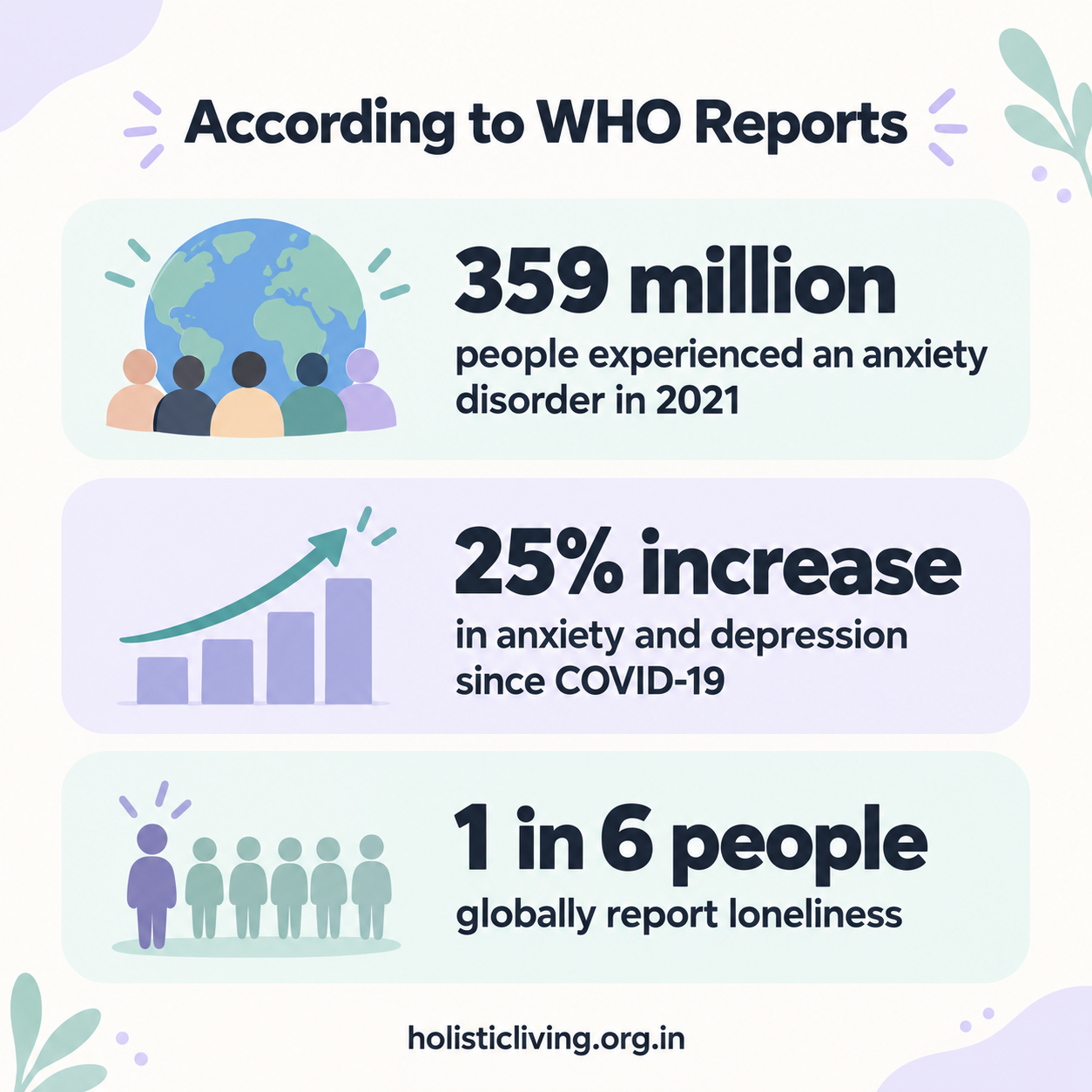
There is good reason for the growing public conversation around anxiety—but it is important not to exaggerate the evidence. According to reports by WHO
- 359 million people experienced an anxiety disorder in 2021
- There is a 25% increase in anxiety and depression since COVID-19
- 1 in 6 people globally report loneliness
At work, the ILO identifies workload, job control, job security, workplace relationships, bullying and work-home pressures among psychosocial risks.
These findings do not prove that smartphones, social media, work pressure or modern life individually “cause anxiety.” They show something more useful: the emotional environments in which people live deserve serious attention.
Anxiety Treatment in India: What Do We Know?
Mental health awareness in India has grown, encouraging more people to recognize anxiety and seek professional support. This has also contributed to better access to counseling, therapy and online mental health services. However, major gaps remain in the availability, affordability and quality of care. Before choosing a therapist or psychologist, individuals should verify their qualifications, professional training, experience, therapeutic approach and ethical standards.
How Anxiety Can Affect Your Life
Relationships
You may become more sensitive to changes in tone, messages, silence or perceived rejection. You may seek reassurance. Or you may withdraw because emotional closeness feels overwhelming.
Career
Anxiety can affect concentration, decision-making, confidence and willingness to take reasonable risks. Someone may be highly capable yet repeatedly avoid presentations, leadership opportunities or difficult conversations.
Sleep
Worry can become particularly loud at night. Without daytime distractions, thoughts may appear more intense. Poor sleep can then leave you less resilient the following day.
Quality of Life
One of the most painful effects of anxiety is not necessarily the symptom itself. It is the gradual shrinking of life. You stop traveling. Then you stop going out. Then you avoid conversations. Then you stop trying things because you are afraid of how you might feel. That is when seeking support becomes especially important.
Anxiety Treatment: What Actually Helps?
There is no single “best” treatment for every person.
Holistic Living Research Team states that generalized anxiety disorder may be treated with psychotherapy, medication or both, depending on individual needs, preferences and medical circumstances.
CBT is a well-studied psychotherapy approach for GAD.
Psychotherapy can help people identify and change troubling thoughts, emotions and behavioral patterns.
Evidence-based approaches for anxiety can include CBT and exposure-based methods, while other approaches may be appropriate depending on the person and problem.
Medication may also have an appropriate role for some people, but should only be used as per the doctor’s discretion. Medicines such as SSRIs and SNRIs are among those used for anxiety disorders, while some anti-anxiety medicines may be used in particular circumstances under medical supervision.
The important question is not, “Which treatment is fashionable?”
It is, “What is appropriate for this person, this anxiety problem and this level of difficulty?”
How Hypnotherapy For Anxiety Can Help
Hypnotherapy deserves a careful and responsible explanation.
Hypnotherapy for anxiety explore the subconscious roots of fears, overthinking, negative beliefs and stress. This can help to tailor a more targeted anxiety treatment, and receive long-term relief and change.
A responsible integrated model is:
Clinical assessment → understanding the anxiety pattern → evidence-based psychological intervention → complementary approaches where appropriate and professionally delivered.
If hypnotherapy is used, it should complement—not automatically replace—appropriate clinical assessment and treatment.
It is also important to remember that anxiety is not simply fear. Anxiety can involve anticipation, uncertainty, worry, avoidance and bodily arousal. The goal of therapy is therefore not merely to “remove fear.” It is to help a person understand what maintains the anxiety and develop healthier ways of responding.
Anxiety Self-Help: Small Things You Can Do When It Feels Overwhelming
If you are not ready for therapy, start with a small step.
Ask yourself: What am I afraid might happen?
Then ask: How often does this thought appear?
And finally: What am I doing to avoid the feeling?
This simple reflection can reveal the anxiety cycle:
Trigger → Thought → Fear → Physical sensation → Avoidance or reassurance → Temporary relief → Anxiety returns
Understanding this cycle is often the beginning of changing it.
Five practical steps you can try today:
- Name what is happening. Instead of “Something is terribly wrong with me,” try “I am experiencing anxiety right now.”
- Separate facts from predictions. Write down what you know versus what you are imagining.
- Reduce avoidance gradually. For significant anxiety, exposure is best planned with an appropriately trained professional.
- Create a calmer physical rhythm. Regular sleep, movement, nutritious meals and periods of relaxation support general well-being.
- Talk instead of carrying everything privately. One honest conversation with someone trustworthy can interrupt isolation.
Self-help is not a replacement for professional care when anxiety is severe, persistent or impairing

When Is the Right Time to Seek Professional Help?
Self-help can be a meaningful first step. But there comes a point when trying to manage everything alone starts becoming another burden.
Here is when professional anxiety treatment becomes necessary:
- Anxiety persists or repeatedly returns
- Interferes with work, study or relationships
- Significantly affects sleep
- Cause substantial avoidance or recurrent panic.
Seeking help early is not an admission of defeat. It is an investment in understanding what is happening.
Here is when medical evaluation is recommended:
- Chest pain with no clear medical cause
- Severe breathing difficulty
- Fainting or other new or severe physical symptoms
If someone is in immediate danger or having thoughts of suicide or self-harm, urgent professional or emergency support should be sought rather than relying on an online article.
What Happens When You See a Therapist for Anxiety?
Many people delay anxiety therapy because they imagine they will be judged.
A first appointment is usually much simpler
A therapist may want to understand what you have been experiencing, when it began, what triggers or worsens it, how it affects sleep and daily functioning, what you currently do to cope, relevant personal or relationship history, and what you hope will change.
You do not need to arrive with a perfectly organized story.
You can simply say:
“I don’t really know what is happening. I just know I don’t feel like myself.”
That is enough to begin.
A suitable professional may then help determine whether anxiety appears to be the primary concern, whether another issue may be involved, and what type of support is appropriate.
How Do You Find the Right Therapist for Anxiety Treatment?
There is no therapist who is automatically right for everyone. Depending on the situation, someone may consider a psychologist, clinical psychologist, counselor, psychiatrist or another appropriately qualified mental-health professional.
The relevant professional depends on the concern and the type of help needed.
For medication assessment, a psychiatrist or other appropriately qualified medical professional may be relevant.
For structured psychotherapy, a psychologist or appropriately trained therapist may be appropriate.
The most useful question is not simply “Who is the best therapist?”
It is: “Who is appropriately qualified for what I am experiencing, and with whom can I build a comfortable therapeutic relationship?”
What Anxiety Is — and What It Is Not
- Anxiety is not just overthinking. It can involve thoughts, emotions, physical arousal and changes in behavior
- Anxiety is not a sign that successful people are immune to struggle. It can affect people across occupations, personalities and life circumstances.
- Knowing a fear is irrational does not always make it disappear. Emotional and bodily responses do not switch off simply because the thinking mind understands them.
- You do not always have to manage it alone. Self-help can be useful, but persistent or impairing anxiety may need professional support.
- Anxiety is not “all in your head.” It involves interactions between psychological processes, brain networks, behavior and bodily responses.
- Therapy does not mean something is seriously wrong with you. It can simply mean you have decided that carrying the problem alone is no longer working.
25 Questions People Ask About Anxiety
1. What does anxiety feel like?
Anxiety can feel like persistent worry, racing thoughts, restlessness, physical tension, a rapid heartbeat, breathlessness, nausea or an inability to relax. It can also feel less obvious, such as irritability, exhaustion or a constant sense that something may go wrong.
2. How do I know if I have an anxiety disorder?
Symptoms alone cannot reliably diagnose an anxiety disorder. A qualified professional considers how often symptoms occur, how intense they are, how long they have continued and whether they interfere with relationships, work, sleep or ordinary daily activities.
3. Can anxiety cause physical symptoms?
Yes. Anxiety can activate the body’s threat-response systems and may be accompanied by sweating, trembling, dizziness, nausea, muscle tension, increased heart rate or breathlessness. Because these symptoms can have other causes, persistent or severe physical symptoms deserve appropriate medical assessment.
4. Why do I feel anxious for no reason?
Sometimes the trigger is obvious; sometimes it is subtle, learned or outside conscious awareness. Physical conditions, medicines and other mental-health concerns can also produce similar sensations. Feeling anxious without understanding why does not mean the experience is imaginary.
5. Can anxiety cause overthinking?
Yes. Anxiety often encourages the mind to keepanalyzingpossibilities, looking for certainty and rehearsing what could go wrong. The thinking may feel productive because it is trying to prevent problems, but repeated “what if?” thinking can keep the nervous system activated.
6. Can anxiety cause sleep problems?
Yes. When the body remains alert and the mind continues reviewing conversations, predicting problems or planning for tomorrow, it can become difficult to settle at night. Poor sleep can then increase emotional sensitivity and make anxiety feel harder to manage the following day.
7. What is the difference between anxiety and fear?
Fear usually responds to an immediate or identifiable threat, while anxiety often centers on anticipated, uncertain or possible threats. They overlap, but anxiety can continue even when nothing dangerous is happening in the present moment, making uncertainty itself feel threatening.
8. Can anxiety cause chest pain?
Anxiety can produce chest sensations, including tightness or discomfort, particularly when the body is highly aroused. However, new, severe or unexplained chest pain should never automatically be attributed to anxiety. Medical assessment may be important, especially when symptoms are unusual.
9. Can anxiety cause dizziness?
Dizziness can occur alongside anxiety, particularly during intense physiological arousal or rapid breathing. However, dizziness has many possible causes. If it is persistent, severe, new or accompanied by other concerning symptoms, it is safer to seek appropriate medical evaluation.
10. Is anxiety curable?
Many people experience substantial improvement with appropriate treatment, support and changes in how they respond to anxiety. It is better not to promise one universal “cure,” because anxiety disorders differ and some people may need ongoing strategies or professional support.
11. What is the best anxiety treatment?
There is no single treatment that is best for everyone. Evidence-based psychotherapy, particularly CBT for many anxiety presentations, is widely used, while medication may also be appropriate for some people depending on symptoms, health, preferences and professional assessment.
12. Does anxiety therapy really work?
Evidence-based psychotherapy can reduce anxiety symptoms and improve functioning for many people. The approach depends on the type of anxiety, the person’s circumstances and therapeutic goals. A good treatment plan is usually individualized rather than based on one method alone.
13. Is CBT good for anxiety?
CBT is one of the best-studied psychological approaches for several anxiety disorders. It can help people recognize unhelpful thinking patterns, change avoidance behaviors and gradually develop more flexible responses to situations that have become associated with fear.
14. Can hypnotherapy help anxiety?
Hypnotherapy may be explored as a complementary approach by some people, particularly around relaxation, emotional patterns and responses to triggers. Evidence varies by condition, so it should not be presented as a universal replacement for established psychological or medical treatment.
15. Can anxiety disappear without treatment?
Mild, temporary anxiety may settle when a stressful situation passes. Persistent, recurring or impairing anxiety is different. If anxiety keeps returning or begins shaping your choices, relationships, sleep or work, professional guidance can help you understand the pattern.
16. Why does anxiety make me avoid things?
Avoidance can provide immediate relief because you no longer have to face the feared situation. The difficulty is that repeated avoidance can strengthen the brain’s expectation that the situation is dangerous, making the next encounter feel even harder.
17. Can anxiety affect relationships?
Yes. Anxiety may make someone more sensitive to silence, tone, rejection or changes in behavior It can lead to reassurance seeking, withdrawal, irritability or difficulty expressing needs. Understanding the anxiety pattern can help people communicate without allowing fear to run the relationship.
18. Can anxiety affect work?
Yes. Anxiety can interfere with concentration, confidence, decision-making, meetings, presentations and attendance. Workplace factors such as workload, job control, job security and interpersonal relationships can also influence mental well-being, which is why workplace anxiety deserves more than a simple “manage your stress” message.
19. Can childhood experiences cause adult anxiety?
Childhood adversity can contribute to vulnerability, especially when experiences repeatedly affect a person’s sense of safety or predictability. But there is no single childhood experience that explains every adult anxiety disorder, and anxiety can develop without an obvious childhood trauma.
20. Why is anxiety common among young people?
Young people face developmental changes alongside academic, social, family and identity-related pressures. Anxiety disorders are among the more common mental-health conditions in adolescence, but prevalence figures should be interpreted carefully and should never be used to label an individual without assessment.
21. Can anxiety happen even when my life is going well?
Yes. Anxiety is not a simple reflection of external circumstances. A person can have a loving family, financial stability or professional success and still experience intense anxiety. Internal threat patterns, biology, learned responses and uncertainty can operate independently of how life appears.
22. Should I see a psychologist or psychiatrist for anxiety?
It depends on what you need. A psychologist or appropriately trained therapist may provide psychotherapy, while a psychiatrist can assess mental-health conditions and prescribe medication when appropriate. Some people benefit from coordinated psychological and medical care.
23. How long does anxiety therapy take?
There is no universal timeline. Duration depends on the type and severity of anxiety, how long the pattern has existed, your goals, the therapeutic approach and your response to treatment. Some people benefit from focused therapy; others need longer-term support.
24. What should I say to a therapist if I don’t know what’s wrong?
You do not need a perfectly organized explanation. You can begin with what you notice: “I cannot switch my mind off,” “I keep worrying,” “I avoid things,” “I cannot sleep,” or “I don’t feel like myself.” That is enough to start.
25. How do I find a therapist for anxiety treatment?
Look for an appropriately qualified professional whose experience matches your concerns and with whom you feel able to speak openly. Holistic Living helps you explore therapist profiles and book an appointment, making the first step easier to take.
Holistic Living Wellness Studio – Anxiety Treatment Center
Holistic Wellness Studio is an ISO-certified therapy and counseling center in Mumbai. Their multidisciplinary team of therapists, counselors and psychologists offer evidence-based anxiety treatment, and has helped thousands of individuals manage anxiety and experience lasting relief.
The center is designed to make the first step toward emotional and mental-health support feel simpler, more informed and less overwhelming.
Holistic Living brings together educational information, therapist discovery and appointment booking so you can move from “I don’t know where to begin” toward “I know what my next step can be.”
The aim is not to diagnose you through a webpage or promise that one approach will work for everyone. It is to help you understand the concern you are facing, explore appropriately qualified professionals and make a more informed choice about starting a conversation.
Whether you are looking for Anxiety Treatment Online, Anxiety Therapy Online, relationship
counseling, emotional support or help with another life concern, the starting point is often finding someone you feel comfortable speaking with.
Holistic Living is a bridge to professional care—not a replacement for it. Because sometimes the hardest part is not admitting that you need support. It is simply knowing where to begin.
A Final Thought About Anxiety
Perhaps the most important thing to understand about anxiety is that the anxious mind is often trying to protect you. It is looking ahead. Checking. Predicting. Preparing.
Trying to make sure that nothing painful, embarrassing, dangerous or uncertain happens.
But a life built entirely around avoiding uncertainty can become a very small life.
You do not have to fight every thought. You do not have to eliminate every uncomfortable feeling. And you do not have to understand your entire history before asking for support.
Sometimes the first step is simply noticing:
“This is affecting my life, and I don’t want to keep carrying it alone.”
That can be enough reason to start a conversation.
Sometimes, you don’t need to have everything figured out. You may simply need one safe conversation.
Just One Conversation.
Find a Therapist | Book an Appointment